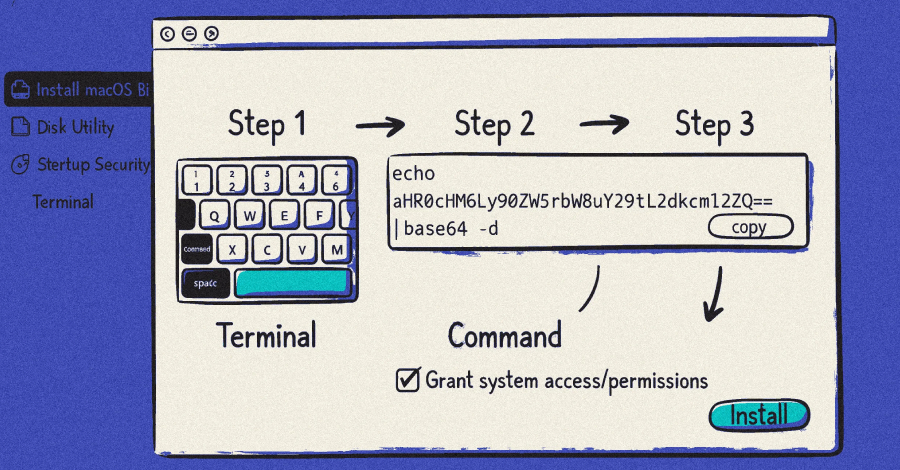
Fake Moltbot AI Coding Assistant on VS Code Marketplace Drops Malware

Cybersecurity researchers have flagged a new malicious Microsoft Visual Studio Code (VS Code) extension for Moltbot (formerly Clawdbot) on the official Extension Marketplace that claims to be a free artificial intelligence (AI) coding assistant, but stealthily drops a malicious payload on compromised hosts. The extension, named “ClawdBot Agent – AI Coding Assistant” (“clawdbot.clawdbot-agent”), has since […]

Continue Reading

Russian ELECTRUM Tied to December 2025 Cyber Attack on Polish Power Grid

Ravie LakshmananJan 28, 2026Critical Infrastructure / Threat Intelligence The “coordinated” cyber attack targeting multiple sites across the Polish power grid has been attributed with medium confidence to a Russian state-sponsored hacking crew known as ELECTRUM. Operational technology (OT) cybersecurity company Dragos, in a new intelligence brief published Tuesday, described the late December 2025 activity as […]

Continue Reading

Two High-Severity n8n Flaws Allow Authenticated Remote Code Execution

Ravie LakshmananJan 28, 2026Vulnerability / Workflow Automation Cybersecurity researchers have disclosed two new security flaws in the n8n workflow automation platform, including a crucial vulnerability that could result in remote code execution. The weaknesses, discovered by the JFrog Security Research team, are listed below – CVE-2026-1470 (CVSS score: 9.9) – An eval injection vulnerability that […]

Continue Reading

Password Reuse in Disguise: An Often-Missed Risky Workaround

When security teams discuss credential-related risk, the focus typically falls on threats such as phishing, malware, or ransomware. These attack methods continue to evolve and rightly command attention. However, one of the most persistent and underestimated risks to organizational security remains far more ordinary. Near-identical password reuse continues to slip past security controls, often unnoticed, […]

Continue Reading

Google Warns of Active Exploitation of WinRAR Vulnerability CVE-2025-8088

Ravie LakshmananJan 28, 2026Vulnerability / Threat Intelligence Google on Tuesday revealed that multiple threat actors, including nation-state adversaries and financially motivated groups, are exploiting a now-patched critical security flaw in RARLAB WinRAR to establish initial access and deploy a diverse array of payloads. “Discovered and patched in July 2025, government-backed threat actors linked to Russia […]

Continue Reading

Fake Python Spellchecker Packages on PyPI Delivered Hidden Remote Access Trojan

Ravie LakshmananJan 28, 2026Supply Chain Security / Malware Cybersecurity researchers have discovered two malicious packages in the Python Package Index (PyPI) repository that masquerade as spellcheckers but contain functionality to deliver a remote access trojan (RAT). The packages, named spellcheckerpy and spellcheckpy, are no longer available on PyPI, but not before they were collectively downloaded […]

Continue Reading

Fortinet Patches CVE-2026-24858 After Active FortiOS SSO Exploitation Detected

Ravie LakshmananJan 28, 2026Network Security / Zero-Day Fortinet has begun releasing security updates to address a critical flaw impacting FortiOS that has come under active exploitation in the wild. The vulnerability, assigned the CVE identifier CVE-2026-24858 (CVSS score: 9.4), has been described as an authentication bypass related to FortiOS single sign-on (SSO). The flaw also […]

Continue Reading

Experts Detect Pakistan-Linked Cyber Campaigns Aimed at Indian Government Entities

Ravie LakshmananJan 27, 2026Threat Intelligence / Cyber Espionage Indian government entities have been targeted in two campaigns undertaken by a threat actor that operates in Pakistan using previously undocumented tradecraft. The campaigns have been codenamed Gopher Strike and Sheet Attack by Zscaler ThreatLabz, which identified them in September 2025. “While these campaigns share some similarities […]

Continue Reading

CTEM in Practice: Prioritization, Validation, and Outcomes That Matter

The Hacker NewsJan 27, 2026Attack Surface Management / Cyber Risk Cybersecurity teams increasingly want to move beyond looking at threats and vulnerabilities in isolation. It’s not only about what could go wrong (vulnerabilities) or who might attack (threats), but where they intersect in your actual environment to create real, exploitable exposure. Which exposures truly matter? […]

Continue Reading

ClickFix Attacks Expand Using Fake CAPTCHAs, Microsoft Scripts, and Trusted Web Services

Cybersecurity researchers have disclosed details of a new campaign that combines ClickFix-style fake CAPTCHAs with a signed Microsoft Application Virtualization (App-V) script to distribute an information stealer called Amatera. “Instead of launching PowerShell directly, the attacker uses this script to control how execution begins and to avoid more common, easily recognized execution paths,” Blackpoint researchers […]

Continue Reading

Microsoft Office Zero-Day (CVE-2026-21509) – Emergency Patch Issued for Active Exploitation

Ravie LakshmananJan 27, 2026Zero-Day / Vulnerability Microsoft on Monday issued out-of-band security patches for a high-severity Microsoft Office zero-day vulnerability exploited in attacks. The vulnerability, tracked as CVE-2026-21509, carries a CVSS score of 7.8 out of 10.0. It has been described as a security feature bypass in Microsoft Office. “Reliance on untrusted inputs in a […]

Continue Reading
Indian Users Targeted in Tax Phishing Campaign Delivering Blackmoon Malware

Ravie LakshmananJan 26, 2026Cyber Espionage / Malware Cybersecurity researchers have discovered an ongoing campaign that’s targeting Indian users with a multi-stage backdoor as part of a suspected cyber espionage campaign. The activity, per the eSentire Threat Response Unit (TRU), involves using phishing emails impersonating the Income Tax Department of India to trick victims into downloading […]

Continue Reading

Malicious VS Code AI Extensions with 1.5 Million Installs Steal Developer Source Code

Ravie LakshmananJan 26, 2026AI Security / Vulnerability Cybersecurity researchers have discovered two malicious Microsoft Visual Studio Code (VS Code) extensions that are advertised as artificial intelligence (AI)-powered coding assistants, but also harbor covert functionality to siphon developer data to China-based servers. The extensions, which have 1.5 million combined installs and are still available for download […]

Continue Reading

⚡ Weekly Recap: Firewall Flaws, AI-Built Malware, Browser Traps, Critical CVEs & More

Ravie LakshmananJan 26, 2026Hacking News / Cybersecurity Security failures rarely arrive loudly. They slip in through trusted tools, half-fixed problems, and habits people stop questioning. This week’s recap shows that pattern clearly. Attackers are moving faster than defenses, mixing old tricks with new paths. “Patched” no longer means safe, and every day, software keeps becoming […]

Continue Reading

Winning Against AI-Based Attacks Requires a Combined Defensive Approach

The Hacker NewsJan 26, 2026Endpoint Security / Artificial Intelligence If there’s a constant in cybersecurity, it’s that adversaries are always innovating. The rise of offensive AI is transforming attack strategies and making them harder to detect. Google’s Threat Intelligence Group, recently reported on adversaries using Large Language Models (LLMs) to both conceal code and generate […]

Continue Reading

Konni Hackers Deploy AI-Generated PowerShell Backdoor Against Blockchain Developers

Ravie LakshmananJan 26, 2026Malware / Endpoint Security The North Korean threat actor known as Konni has been observed using PowerShell malware generated using artificial intelligence (AI) tools to target developers and engineering teams in the blockchain sector. The phishing campaign has targeted Japan, Australia, and India, highlighting the adversary’s expansion of the targeting scope beyond […]

Continue Reading

Multi-Stage Phishing Campaign Targets Russia with Amnesia RAT and Ransomware

A new multi-stage phishing campaign has been observed targeting users in Russia with ransomware and a remote access trojan called Amnesia RAT. “The attack begins with social engineering lures delivered via business-themed documents crafted to appear routine and benign,” Fortinet FortiGuard Labs researcher Cara Lin said in a technical breakdown published this week. “These documents […]

Continue Reading

New DynoWiper Malware Used in Attempted Sandworm Attack on Polish Power Sector

Ravie LakshmananJan 24, 2026Malware / Critical Infrastructure The Russian nation-state hacking group known as Sandworm has been attributed to what has been described as the “largest cyber attack” targeting Poland’s power system in the last week of December 2025. The attack was unsuccessful, the country’s energy minister, Milosz Motyka, said last week. “The command of […]

Continue Reading

Who Approved This Agent? Rethinking Access, Accountability, and Risk in the Age of AI Agents

AI agents are accelerating how work gets done. They schedule meetings, access data, trigger workflows, write code, and take action in real time, pushing productivity beyond human speed across the enterprise. Then comes the moment every security team eventually hits: “Wait… who approved this?” Unlike users or applications, AI agents are often deployed quickly, shared […]

Continue Reading

CISA Adds Actively Exploited VMware vCenter Flaw CVE-2024-37079 to KEV Catalog

Ravie LakshmananJan 24, 2026Vulnerability / Enterprise Security The U.S. Cybersecurity and Infrastructure Security Agency (CISA) on Friday added a critical security flaw affecting Broadcom VMware vCenter Server that was patched in June 2024 to its Known Exploited Vulnerabilities (KEV) catalog, citing evidence of active exploitation in the wild. The vulnerability in question is CVE-2024-37079 (CVSS […]

Continue Reading

CISA Updates KEV Catalog with Four Actively Exploited Software Vulnerabilities

Ravie LakshmananJan 23, 2026Vulnerability / Software Security The U.S. Cybersecurity and Infrastructure Security Agency (CISA) on Thursday added four security flaws to its Known Exploited Vulnerabilities (KEV) catalog, citing evidence of active exploitation in the wild. The list of vulnerabilities is as follows – CVE-2025-68645 (CVSS score: 8.8) – A PHP remote file inclusion vulnerability […]

Continue Reading

Fortinet Confirms Active FortiCloud SSO Bypass on Fully Patched FortiGate Firewalls

Ravie LakshmananJan 23, 2026Network Security / Vulnerability Fortinet has officially confirmed that it’s working to completely plug a FortiCloud SSO authentication bypass vulnerability following reports of fresh exploitation activity on fully-patched firewalls. “In the last 24 hours, we have identified a number of cases where the exploit was to a device that had been fully […]

Continue Reading

TikTok Forms U.S. Joint Venture to Continue Operations Under 2025 Executive Order

Ravie LakshmananJan 23, 2026Regulatory Compliance / National Security TikTok on Friday officially announced that it formed a joint venture that will allow the hugely popular video-sharing application to continue operating in the U.S. The new venture, named TikTok USDS Joint Venture LLC, has been established in compliance with the Executive Order signed by U.S. President […]

Continue Reading

Phishing Attack Uses Stolen Credentials to Install LogMeIn RMM for Persistent Access

Ravie LakshmananJan 23, 2026Email Security / Endpoint Security Cybersecurity researchers have disclosed details of a new dual-vector campaign that leverages stolen credentials to deploy legitimate Remote Monitoring and Management (RMM) software for persistent remote access to compromised hosts. “Instead of deploying custom viruses, attackers are bypassing security perimeters by weaponizing the necessary IT tools that […]

Continue Reading

Microsoft Flags Multi-Stage AitM Phishing and BEC Attacks Targeting Energy Firms

Microsoft has warned of a multi‑stage adversary‑in‑the‑middle (AitM) phishing and business email compromise (BEC) campaign targeting multiple organizations in the energy sector. “The campaign abused SharePoint file‑sharing services to deliver phishing payloads and relied on inbox rule creation to maintain persistence and evade user awareness,” the Microsoft Defender Security Research Team said. “The attack transitioned […]

Continue Reading